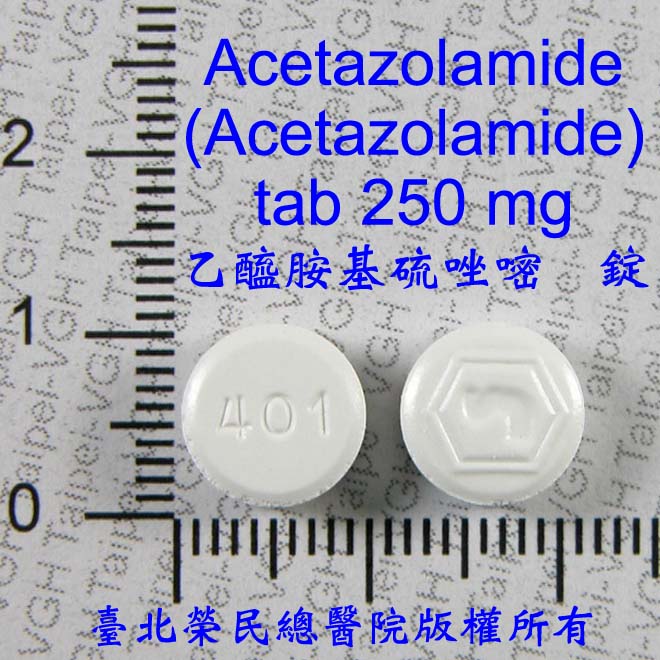
Acetazolamide, it is an carbonic anhydrase inhibitor.
Acetazolamide
Acetazolamide, Diamox, Diacarb, Glaupax, Acetazolamid
Abzole, Avva, Acetamide, Acetariv, Acetamin, Diamox, Iopar-S, Synomax, Zolamide
N-(5-sulfamoyl-1,3,4-thiadiazol-2-yl)acetamide
Acetazolamide is a potent carbonic anhydrase inhibitor, effective in the control of fluid secretion, in the treatment of certain convulsive disorders and in the promotion of diuresis in instances of abnormal fluid retention. Acetazolamide is not a mercurial diuretic. Rather, it is a nonbacteriostatic sulfonamide possessing a chemical structure and pharmacological activity distinctly different from the bacteriostatic sulfonamides.
The dose ranges from 250 mg to 1 g for 24 hours, usually in divided doses.
Acetazolamide used as a diuretic, for epileptic seizures, glaucoma, benign intracranial hypertension (pseudotumor cerebri), altitude sickness, cystinuria, and dural ectasia.
Drowsiness, ataxia, paraesthesia, anorexia, confusion, dizziness, thirst, depression, headache; malaise, GI distress, metabolic acidosis, polyuria, hyperuricaemia, renal calculi, nephrotoxicity, hepatic dysfunction.
Pregnancy and lactation. Hypersensitivity to sulphonamides, hepatic cirrhosis, potassium or sodium depletion, hepatic insufficiency, severe renal impairment, hyperchloraemic acidosis, severe pulmonary obstruction, adrenocortical insufficiency, chronic noncongestive angle-closure glaucoma.
222.245
C4H6N4O3S2
59-66-5