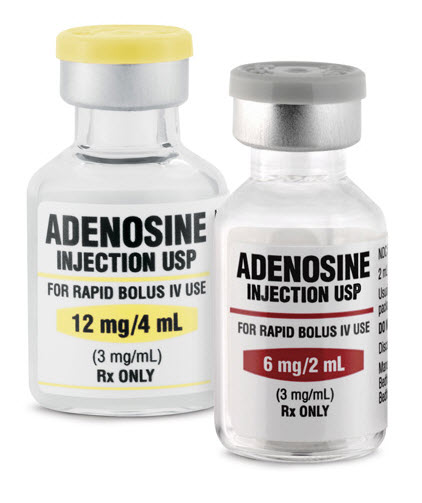
Adenosine is a nucleoside that occurs naturally in all cells of the body. Chemically it is 6-amino-9-beta-D-ribofuranosyl-9-H-purine.
Adenosine
Adenosine, Adenoscan, Adenocard, Adenine riboside
Adenocor, Adenoject, Cadsine, Adenoz, Carnosin, Tachyban
(2R, 3R, 4S, 5R)-2-(6-amino-9H-purin-9-yl)-5-(hydroxymethyl) oxolane-3, 4-diol
Rapidly taken up into the erythrocytes and vascular endothelial cells. Metabolised to adenosine monophosphate and inosine.
Adenosine is not chemically related to other antiarrhythmic drugs, it is an endogenous nucleoside occurring in all cells of the body. Adenosine may exert its pharmacologic effects by activation of purine receptors (cell surface A1 and A2 adenosine), as well as relax vascular smooth muscles through the reduction in calcium uptake by inhibition of slow inward calcium current and activation of adenylate cyclase in smooth muscle cells. This may reduce a vascular tone by modulation of sympathetic neurotransmission. The drug also has negative dromotropic, chronotropic, and inotropic affects on the heart by slowing conduction time throught he AV node and interrupting AV nodal reentry pathways.
Initial dose 6 mg via IV bolus, if the first dose does not work administer 12 mg.
Prescribed for irregular heartbeat, it’s an Antiarrhythmic agent.
Chest pain, shortness of breath, headache, nausea, numbness, flushing, dizziness, blurred vision and metallic taste.
Contraindications in patients with hypersensitivity, slow heartbeat and in second or third AV block patients.
Store at 68 ? to 77 °F (20 to 25).
267.2413
C10H13N5O4
58-61-7
Caution should be exercised in patients with history of gout, allergy, lung disorders, during pregnancy and breast feeding. Monitor ECG while taking this medication.