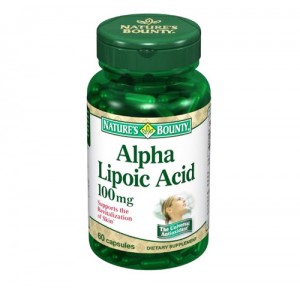
Lipoic acid (LA), also known as ?-lipoic acid and alpha lipoic acid (ALA) and thioctic acid is an organosulfur compound derived from octanoic acid. More
Lipoic acid (LA), also known as ?-lipoic acid and alpha lipoic acid (ALA) and thioctic acid is an organosulfur compound derived from octanoic acid.
Alpha-Lipoic acid
Dl-Thioctic acid, Thioctic acid, Alpha-Lipoic acid, 5-(1, 2-Dithiolan-3-yl) pentanoic acid
Acmic-Alpha, A to Z Gold NS, Absolut-DM, Acobmin Forte, Acteva, Acteva-DM, Agemax-G, Alcrin-M, Alfaden Plus, Almecol-B, Alnacob-OD, Axo-Vit, Azed-M, B-29, Barovit, Basix-AL, Berocin-CZ, Bigvin Plus, Cobaday-AV, Cobal Forte
5-(1, 2-dithiolan-3-yl) pentanoic acid
Lipoic Acid is generally involved in oxidative decarboxylations of keto acids and is presented as a growth factor for some organisms. Lipoic acid exists as two enantiomers, the R-enantiomer and the S-enantiomer. Normally only the R-enantiomer of an amino acid is biologically active, but for lipoic acid the S-enantiomer assists in the reduction of the R-enantiomer when a racemic mixture is given. Some recent studies have suggested that the S-enantiomer in fact has an inhibiting effect on the R-enantiomer, reducing its biological activity substantially and actually adding to oxidative stress rather than reducing it. Furthermore, the S-enantiomer has been found to reduce the expression of GLUT-4s in cells, responsible for glucose uptake, and hence reduce insulin sensitivity.
1 mcg/day
Nutritional supplement and antioxidant.
Constipation or diarrhea, anorexia, nausea and vomiting, polyuria, sweating, nocturia, headache, somnolence thirst, vertigo and hypercalcaemia.
Thiazides may increase the risk of hypercalcaemia.
Infants, pregnancy, lactation, renal impairment
206.326
C8H14O2S2
62-46-4
Avoid in patients with hypersensitivity to inj. containing propylene glycol.