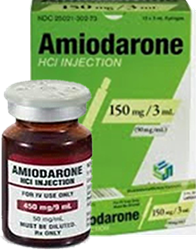
Amiodarone is an antiarrhythmic medication used to treat and prevent a number of types of irregular heartbeats. More
Amiodarone is an antiarrhythmic medication used to treat and prevent a number of types of irregular heartbeats.
Amiodarone
Amiodarone, Amiodarona, Cordarone, Amiodaronum, Amjodaronum
Aldarone, Biodaron, Cardasol, Duron, Eurythmic, Panaron, Ritebeat, Tachyra, Amiodar, Amiodon, Amipace, Cardichek, Cordarone, Cordarone-X.
{2-[4-(2-butyl-1-benzofuran-3-carbonyl)-2,6 diiodophenoxy]ethyl}diethylamine
It is Class III antiarrhythmic agents, used in the treatment of a wide range of cardiac tachyarrhythmia’s, including both supraventricular and ventricular arrhythmias. After IV administration in man, amiodarone relaxes vascular smooth muscle, reduces peripheral vascular resistance (afterload), and slightly increases cardiac index. The antiarrhythmic effect of amiodarone may be due to at least two major actions. It prolongs the myocardial cell-action potential (phase 3) duration and refractory period and acts as a noncompetitive a- and b-adrenergic inhibitor.
Ventricular arrhythmia and ventricular tachycardia.
Pulmonary toxicity including pulmonary fibrosis and interstitial pneumonitis, hepatotoxicity, thyrotoxicity. Blue-grey discolouration of skin, photosensitivity, paraesthesia, peripheral neuropathy, ataxia, myopathy, nausea, tremor, vomiting, hypothyroidism, metallic taste, hyperthyroidism, alopoecia, sleep disturbances, corneal microdeposits, hot flushes, sweating.
645.3116
C25H29I2NO3
1951-25-3
Close monitoring is recommended as amiodarone may worsen arrhythmia especially when used concurrently with other anti-arrhythmic drugs or drugs that prolong QT interval. May cause hypotension and bradycardia. May increase risk of liver toxicity. Avoid excessive sunlight exposure due to increased risk of photosensitivity.