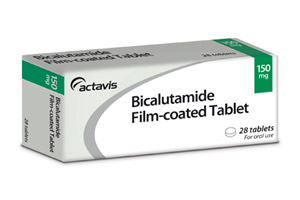
Bicalutamide, sold under the brand name Casodex among others, is an antiandrogen medication that is primarily used to treat prostate cancer. It is typically used together with a gonadotropin-releasing hormone (GnRH) analogue or surgical removal of the testicles to treat metastatic prostate cancer. More
Bicalutamide, sold under the brand name Casodex among others, is an antiandrogen medication that is primarily used to treat prostate cancer. It is typically used together with a gonadotropin-releasing hormone (GnRH) analogue or surgical removal of the testicles to treat metastatic prostate cancer.
Bicalutamide-antiandrogen medication that is primarily used to treat prostate cancer.
Casodex; Cosudex; ICI 176334
Androblok, Bicalon, Biprosta, Caludec, Caluran, Caluran-CP, Calutide-50, Casodex, Cluta-B, Cosalon, Utamide
N-[4-cyano-3-(trifluoromethyl) phenyl]-3-(4-fluorobenzenesulfonyl)-2-hydroxy-2-methylpropanamide
It competes with androgen for the binding of androgen receptors, consequently blocking the action of androgens of testicular and adrenal origin that stimulate the growth of malignant and normal prostatic tissue.
50mg once daily per oral
For advanced prostate cancer
Nausea, vomiting, diarrhoea, asthenia, gynaecomastia, hot flushes, pruritus, dry skin, alopecia, hirsutism, weight gain; decreased libido, impotence, intestinal lung disease; urticaria, rarely abdominal pain, CV disorders .
Enhances effects of coumarin anticoagulants
Hypersensitivity
Store it at controlled room temperature.
430.373
C18H14F4N2O4S
90357-06-5
Monitor liver function regularly in hepatically impaired patients on prolonged therapy. Monitoring serum levels of Prostate Specific Antigen (PSA) may be useful in evaluating the patients’ clinical progress.