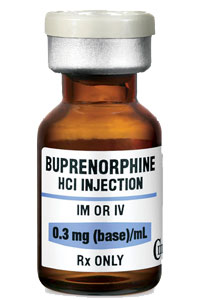
Buprenorphine is used in medication-assisted treatment (MAT) to help people reduce or quit their use of heroin or other opiates More
Buprenorphine is used in medication-assisted treatment (MAT) to help people reduce or quit their use of heroin or other opiates
Buprenorphine-an opioid used to treat opioid addiction, moderate acute pain and moderate chronic pain
Buprenex; Temgesic; Buprenorfina; Buprenorphinum
Addnok, Bunogesic, Buprigesic, Buprine, Buprinor, Norphin, Pentorel, Qudict, Tidigesic.
(1S,2R,6S,14R,15R,16R)-3-(cyclopropylmethyl)-16-[(2S)-2-hydroxy-3,3-dimethylbutan-2-yl]-15-methoxy-13-oxa-3-azahexacyclo[13.2.2.1²,?.0¹,?.0?,¹?.0?,¹²]icosa-7,9,11-trien-11-ol.
Buprenorphine's analgesic effect is due to partial agonist activity at mu-opioid receptors. Buprenorphine is also a kappa-Opioids receptor antagonist, binding to kappa and mu receptors results in hyper polarization and reduced neuronal excitability. Furthermore, buprenorphine slowly dissociates from its receptor.
The recommended dose is 0.3 to 0.6 mg by IM/IV/SC routes.0.2 to 0.4 mg ¾ times a day sublingual.
Prescribed for moderate to severe pain.
Sedation, nausea, dizziness, hypotension, vertigo, miosis, headache, respiratory or CNS depression; hypoventilation, tachycardia, urinary retention, bradycardia, coma, vomiting, drowsiness, sweating, confusion, dry mouth, diaphoresis, withdrawal syndrome.
· Enhanced depressant effects with other CNS depressants e.g. anaesthetics, alcohol, anxiolytics, hypnotics, TCAs and antipsychotics. Diazepam may produce respiratory and cardiac collapse.
· Plasma-buprenorphine concentrations may be affected when co-administered with drugs that induce or inhibit cytochrome P450 isoenzyme CYP3A4.
Store at 15-30°C.
467.6401
C29H41NO4
52485-79-7