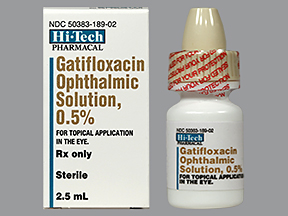
Gatifloxacin sold under the brand names Gatiflo, Tequin and Zymar, is an antibiotic of the fourth-generation fluoroquinolone family, that like other members of that family, inhibits the bacterial enzymes DNA gyrase and topoisomerase IV. More
Gatifloxacin sold under the brand names Gatiflo, Tequin and Zymar, is an antibiotic of the fourth-generation fluoroquinolone family, that like other members of that family, inhibits the bacterial enzymes DNA gyrase and topoisomerase IV.
Gatifloxacin
Gatifloxacin; Tequin; Zymar; Gatiflo
Adgat, Algat, Amgat, Avigat, C-Gat, Dasikon, Diragyl, Ecogat, Ecogat BCD, Engatt, Engatt-DX, Floxigat, Floxigat M, Flurogat, G –Cebran, Gabact, Gabee, Gabir DPS, Gaity, Garnid, Gate Eye DPS, Gate-DX DPS, Gateme, Gatiaid-F, Gatiba, Gatiblu, Gatiblu-D, Gaticin, Gaticin Conc. INJ, Gaticin DPS, Gatifect, Gatiflo, Gatigo, Gatigram, Gatigram Oz, Gatik, Gatikind DPS, Gatilab, Gatilink, Gatilox, Gatilox DPS, Gatilox-DM, Gatimore, Gatin, Gatiquin, Gatiquin DPS, Gatiquin OINT, Gatiquin-OZ, Gatiquin-P, Gatispan
1-cyclopropyl-6-fluoro-8-methoxy-7-(3-methylpiperazin-1-yl)-4-oxo-1,4-dihydroquinoline-3-carboxylic acid
Oral absorption.
Gatifloxacin is a synthetic broad-spectrum 8-methoxyfluoroquinolone antibacterial agent active against both Gram-positive and Gram-negative bacteria for oral or intravenous administration. It is bactericidal and its mode of action depends on blocking of bacterial DNA replication by binding itself to an enzyme called DNA gyrase, which allows the untwisting required replicating one DNA double helix into two.
400 mg once daily.
For the treatment of bronchitis, sinusitis, community-acquired pneumonia, and skin infections (abscesses, wounds) caused by S. pneumoniae, H. influenzae, S. aureus, M. pneumoniae, C. pneumoniae, L. pneumophila, S. pyogenes
Rapid heartbeat, mental confusion, hallucinations, agitation, nightmares, depression; photophobia; tendon rupture; headache, dizziness, insomnia, chills, fever; back pain, abdominal pain; constipation, nausea, vomiting, diarrhoea, inflammation of the tongue, mouth sores; abnormal vision, ringing in the ears, vaginitis.
Hypersensitivity; children <18 years; concurrent use of class IA or III antiarrhythmics, QT-prolongation drugs; diabetics; pregnancy, lactation.
Store at 25°C.
375.3941
C19H22FN3O4
112811-59-3
Elderly. Uncorrected hypokalaemia; renal and hepatic impairment. Known or suspected CNS disorders, May prolong QT interval