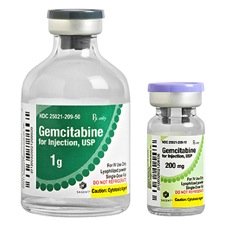
Gemcitabine, sold under the brand name Gemzar, among others, is a chemotherapy medication used to treat a number of types of cancer. More
Gemcitabine, sold under the brand name Gemzar, among others, is a chemotherapy medication used to treat a number of types of cancer.
Gemcitabine
Gemcitabine; Gemzar; 2',2'-Difluorodeoxycytidine; Gemcitabina
Celgem, Abingem, Celzar, Biogem, Cytogem, Gem-On, Emcitaben, Gemacta, Gembin, Gemcite, Gemcimine, Gemitrate, Gemita, Gemizan, Gempower, Gemspera, Gemtaz, Lifogem, Oncogem, Shancyte, Xtroz
4-amino-1-[(2R,4R,5R)-3,3-difluoro-4-hydroxy-5-(hydroxymethyl)oxolan-2-yl]-1,2-dihydropyrimidin-2-one
Excreted in urine.
Gemcitabine is an antineoplastic anti-metabolite. Anti-metabolites masquerade as purine or pyrimidine - which become the building blocks of DNA. They prevent these substances becoming incorporated in to DNA during the "S" phase (or DNA synthesis phase of the cell cycle), stopping normal development and division.
1000 mg/m2 on days 1, 8 and 15 of each 28-day cycle; or 1250 mg/m2 on days 1 and 8 of each 21-day cycle as IV.
Used to treat certain types of cancers.
Bone marrow suppression as manifested by leukopenia, thrombocytopenia, anaemia and myelosuppression. Rashes; influenza-like symptoms; renal impairment, interstitial pneumonia, pulmonary toxicity, pulmonary oedema. Proteinuria, haematuria and haemolytic uraemic syndrome. Elevation of serum transaminase. Potentially Fatal: Oesophagitis and pneumonitis when given with radical radiotherapy to the thorax.
May increase the anticoagulant effect of warfarin when used together.
Concurrent radical radiotherapy; pregnancy, lactation; hypersensitivity
Store at 25 ?
263.1981
C9H11F2N3O4
95058-81-4