Hyaluronidases are a family of enzymes that catalyse the degradation of hyaluronic acid (HA). Karl Meyer classified these enzymes in 1971 into three distinct groups, a scheme based on the enzyme reaction products. More
Hyaluronidases are a family of enzymes that catalyse the degradation of hyaluronic acid (HA). Karl Meyer classified these enzymes in 1971 into three distinct groups, a scheme based on the enzyme reaction products.
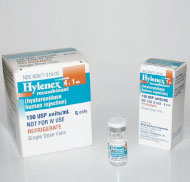
Hyaluronidase
2,4-bis(1,3-benzodioxol-5-yl)-4-oxobutanoic acid; CHEMBL2000337; 9001-54-1; 88755-39-9; Hyaluronidase from streptomyces hyaluro-lyticus, 0.1uvial
Facidase, Facidase INJ, Hylorase, Hynidase, Spreadase
NA
NA
Hyaluronidase hydrolyzes hyaluronic acid and increase diffusion of injected drugs, thus facilitating their absorption. Hyaluronidase is used for enhancing absorption and distribution of other injected drugs.
NA
For increase of absorption and distribution of other injected drugs and for rehydration.
Hypersensitivity and anaphylaxis. Urticaria, occasional severe allergy.
Hypersensitivity, malignancy. Direct application to the cornea, reduction of swelling of bites or stings. Inj into or around infected area. IV admin; unexplained premature labour.
Refrigerate at 2-8°C
C2455H3775N617O704S21
53870.9 Da
NA
Impaired renal function. Infants, elderly. Patients with infections. Pregnancy, lactation.