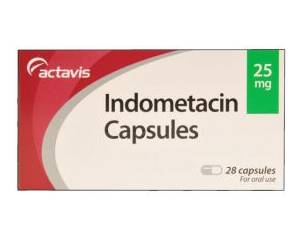
It is a nonsteroidal anti-inflammatory drug (NSAID) commonly used as a prescription medication to reduce fever, pain, stiffness, and swelling from inflammation. More
It is a nonsteroidal anti-inflammatory drug (NSAID) commonly used as a prescription medication to reduce fever, pain, stiffness, and swelling from inflammation.
Indometacin or Indomethacin
Indomethacin; Indometacin; Indocin; Indomethacine
Artisid, Donica, Donica-SR, Ducain, Idicin, Indocap, Indocid, Indoflam, Indoflam EYE, Indoriv, Inmecin, Inmecin-P, Inmecin-R, Inocin, Lygacin, Microcid, Recticin
2-[1-(4-chlorobenzoyl)-5-methoxy-2-methyl-1H-indol-3-yl]acetic acid
It is also known as cyclooxygenase or COX inhibitor (a prostaglandin G/H synthase)that acts on both prostaglandin G/H synthase 1 and 2 (COX-1 and -2). Prostaglandin G/H synthase catalyzes the conversion of arachidonic acid to a number of prostaglandins involved in fever, pain, swelling, inflammation, and platelet aggregation. The antipyretic, analgesic and anti-inflammatory activity of indomethacin occur as a result of decreased prostaglandin synthesis.
Treatment for osteoarthritis, ankylosing spondylitis, acute painful shoulder (bursitis and/or tendinitis) and acute gouty arthritis.
Renal failure, GI upsets, tinnitus, headache, dizziness, lightheadedness, psychiatric disturbances, depression, peripheral neuropathy, insomnia, blurred vision, confusion; hyperglycaemia, hyperkalaemia.
Active peptic ulcer; pregnancy (3rd trimester), hypersensitivity to aspirin and other NSAIDs; treatment of perioperative pain in CABG surgery; severe renal impairment; rectal admin in patients with proctitis and haemorrhoids; neonates with necrotizing enterocolitis, active bleeding, thrombocytopenia, coagulation defects and untreated infections.
Store below 30°C.
357.788
C19H16ClNO4
53-86-1