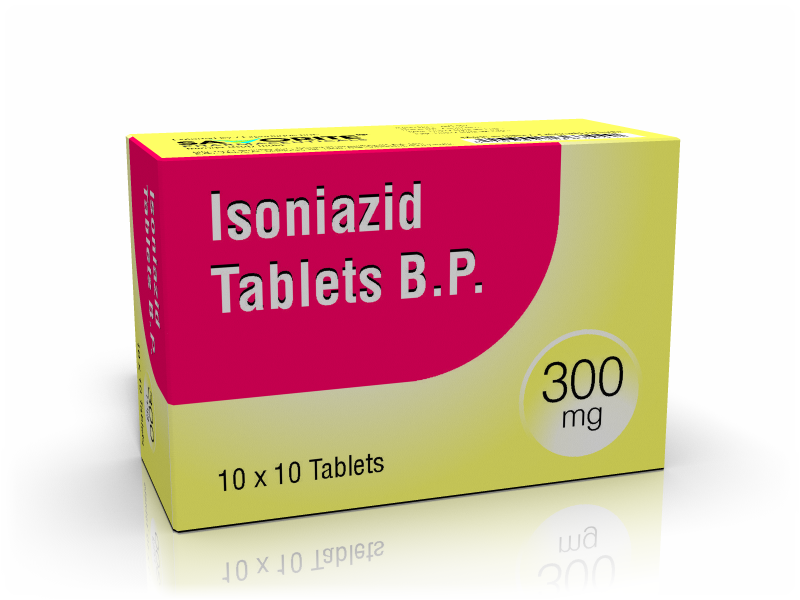
Also known as isonicotinylhydrazide (INH), is an antibiotic used for the treatment of tuberculosis.
Isoniazid
Isoniazid; Isonicotinic acid hydrazide; Isonicotinohydrazide; 54-85-3; Pyridine-4-carbohydrazide
Myconx-800, 3-Fd, 4-D, 4-D Plus, Acrifa, Acrifa Forte, Acrifa Plus, Acrifa-DS, Afb3, Afb4, Akt-2, Akt-3, Akt-4, Akt-FD, Akurit, Akurit Kid, Akurit-3, Akurit-4, Akurit-Z, Akurit-Z Kid, Antibin, Antibin-Kid, Arzade, Becox, Becox Forte, Becox-RH, Bicox Kid, Bicox Kid Forte, Bicox-600, Bicox-E, Bicox-Kid 50, Binex, Binex Kid, Binex-DT, Binex-E, Binex-Z, Binex-ZE, Bionex Plus, Cavidin-INH, Cavirip-1000, Caviter, Caviter-FD, Caviter-RHE, Combunex, Confez-3, Coxcure-4, Coxina-3, Coxina-4, Coxinex, Coxkit-3
pyridine-4-carbohydrazide
Oral absorption
It is a bactericidal agent active against organisms of the genus Mycobacterium, specifically M. tuberculosis, M. bovis and M. kansasii. It is a highly specific agent, ineffective against other microorganisms.
5mg/kg up to 300 mg daily in a single dose; or 15 mg/kg up to 900 mg/day, two or three times/week.
For the treatment of all forms of tuberculosis in which organisms are susceptible.
Fever, optic neuritis; convulsions, psychotic reactions, nausea, fatigue, vomiting, visual disturbances, epigastric distress, rash, and pyridoxine deficiency. Hepatotoxicity. Peripheral neuritis.
Acute liver disease or history of hepatic damage during INH therapy; hypersensitivity.
Store at 59°-86° F (15°-30° C).
137.1393
C6H7N3O
54-85-3