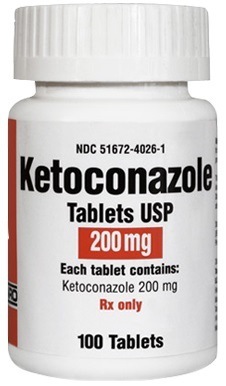
Ketoconazole is an oral drug that's used to treat fungal infections. More
Ketoconazole is an oral drug that's used to treat fungal infections.
Ketoconazole-used to treat certain serious fungal infections in the body
Ketoconazole; Panfungol; Nizoral; Orifungal M; Ketoderm
Abiket, Abket Soap, Apodruff, Arclone, Arcolane Scalp Soln, At-Last, Atron, Beetoc, Beetoc Shampoo, Beetoc Soap, Can, Can Tab, Can-Z, Clinhair, Clopeta-C, Clopeta-Z, Conaderm, Cotar-K, D-Keto, Danclear, Dancure, Dandcare,
1-[4-(4-{[2-(2,4-dichlorophenyl)-2-(1H-imidazol-1-ylmethyl)-1,3-dioxolan-4-yl]methoxy}phenyl)piperazin-1-yl]ethan-1-one
Ketoconazole interacts with 14-α demethylase, a cytochrome P-450 enzyme necessary for the conversion of lanosterol to ergosterol. This results in inhibition of ergosterol synthesis and increased fungal cellular permeability. Other mechanisms may involve the interaction with membrane phospholipids, inhibition of endogenous respiration, inhibition of yeast transformation to mycelial forms, inhibition of purine uptake, and impairment of triglyceride and/or phospholipid biosynthesis. Ketoconazole can also inhibit the synthesis of thromboxane and sterols such as aldosterone, cortisol, and testosterone.
200 to 400 mg daily by oral. Topical formulation applied on the affected area once or twice a day.
For the treatment of candidiasis, oral thrush, chronic mucocutaneous candidiasis, candiduria, blastomycosis, coccidioidomycosis, histoplasmosis, chromomycosis, and paracoccidioidomycosis.
GI disturbances e.g. nausea and vomiting; rash, dermatitis, burning sensation, pruritus; headache, dizziness, somnolence, fever and chills; thrombocytopenia; gynaecomastia, impotence; raised intracranial pressure; photophobia; transient elevations in LFTs. Potentially Fatal: Hepatotoxicity.
Hypersensitivity; preexisting liver disease, porphyria. Concurrent use with cisapride, terfenadine or astemizole.
Store at 59-77 ° F (15-25 ?).
531.431
C26H28Cl2N4O4
65277-42-1