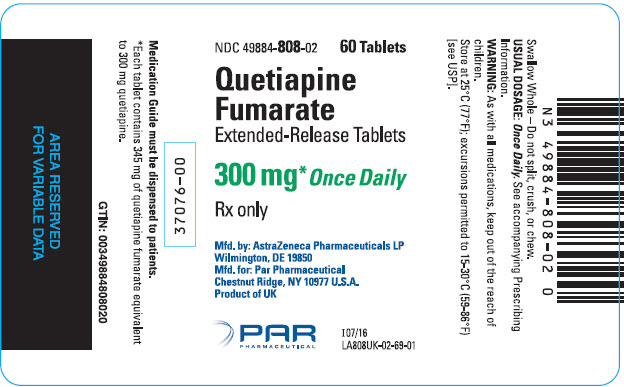
This medication is used to treat certain mental/mood conditions (such as schizophrenia, bipolar disorder, sudden episodes of mania or depression associated with bipolar disorder). Quetiapine is known as an anti-psychotic drug (atypical type). More
This medication is used to treat certain mental/mood conditions (such as schizophrenia, bipolar disorder, sudden episodes of mania or depression associated with bipolar disorder). Quetiapine is known as an anti-psychotic drug (atypical type).
Quetiapine fumarate-This medication is used to treat certain mental/mood conditions
Quetiapine fumarate; Quetiapine hemifumarate; Seroquel XR; UNII-2S3PL1B6UJ
Adequet, Esq, Pincalm, Placidin, Psynil, Q Pin, Q-Mind, Q-Win, Qtf, Qtf-SR, Quel, Quel-SR, Queticare, Quetimax, Quitsun, Qurea, Quser, Quser-XL, Qutace, Qutace-SR, Qutan, Quticool, Quticool-SR, Qutipin, Qutipin-SR, Seroqui
2-[2-(4-{2-thia-9-azatricyclo[9.4.0.0³,?]pentadeca-1(15),3,5,7,9,11,13-heptaen-10-yl}piperazin-1-yl)ethoxy]ethan-1-ol
Quetiapine is a psychotropic agent belonging to the chemical class of benzisoxazole derivatives and is indicated for the treatment of schizophrenia. Quetiapine is a selective monoaminergic antagonist with high affinity for the serotonin Type 2 (5HT2), and dopamine type 2 (D2) receptors. It is an antagonist at dopamine D1 and D2, serotonin 5-HT1A and 5HT2, histamine H1, and adrenergic alpha 1 and alpha 2 receptors. Quetiapine has no significant affinity for cholinergic muscarinic or benzodiazepine receptors. Quetiapine's antagonism of adrenergic a1 receptors may explain the orthostatic hypotension observed with this drug.
Initial dose is 25-50 mg twice a day, may increase dose 750-800 mg per day.
Used in the management of schizophrenia, bipolar I depression, bipolar I mania, bipolar II depression, insomnia and anxiety disorders.
Headache, asthenia, abdominal pain, back pain, fever, chest pain, postural and orthostatic hypotension, hypertension, constipation, dry mouth, dyspepsia, diarrhoea, leucopenia, elevations in serum transaminase level, weight gain, myalgia, somnolence, dizziness, anxiety, rhinitis, rash, dry skin, ear pain, UTI, syncope, neuroleptic malignant syndrome, variations in WBC count, neutropenia, eosinophilia, elevations in nonfasting serum triglyceride level and total cholesterol, decrease in thyroid hormone levels, prolongation of the QTc interval.
Severe CNS depression, bone marrow suppression, coma.
Store at 25°C.
383.507
C21H25N3O2S
111974-72-2