Ranitidine
Ranitidine; 66357-35-5; ZANTAC; Gastrosedol; Coralen
Aciba, Acidom-O, Aciloc, Aciloc-RD, Acispas, Actispas-R, Advene, Alcirid-O, Alotac, Amylocarb, Ancid, Andom, Antac, Asispas, Avispas, Aztec, Aztec-D, Becotac, Candotac-O, Consec, Coretac, Cotac, Cycloran, Cypatec, Cypatec-D, Din, Dom-R, Dom-T, Domar, Domar-O, Domny-R, Doran-O, Emtec, Entac, Fydom-R, Fydon-R, Gaspaz, Giran, Healcer, Helkoss, Helkoss-D, Histac, Hytide, Intac, Kamtac, Lantac, Lydin, Manotac, Manotac Plus, Meditin
dimethyl [(5-{[(2-{[(E)-1-(methylamino)-nitroethenyl]amino}ethyl)sulfanyl]methyl}furan-2-yl)methyl]amine
Hepatic metabolism.
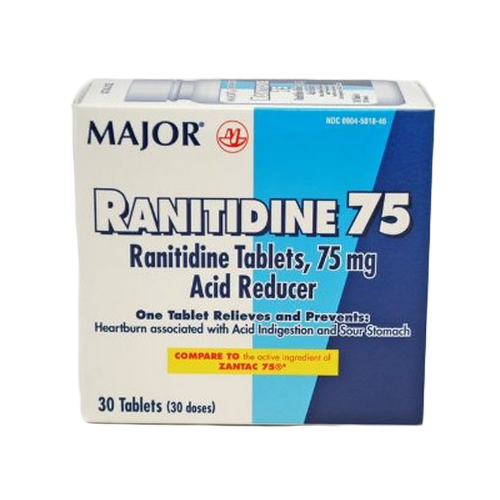
It is a histamine H2-receptor antagonist used to block the action of histamine on parietal cells in the stomach, decreasing acid production by these cells.
The recommended dose is 300 mg at bedtime or 150 mg twice daily for 4-8 weeks depending on the condition per oral.
Used in the treatment of peptic ulcer disease (PUD), dyspepsia, stress ulcer prophylaxis, and gastroesophageal reflux disease (GERD).
Headache, dizziness hepatitis thrombocytopaenia, confusion, leucopaenia, hypersensitivity, impotence, gynaecomastia, somnolence, vertigo, hallunications. Anaphylaxis, hypersensitivity reactions.
Porphyria
59° to 86°F
314.404
C13H22N4O3S
66357-35-5