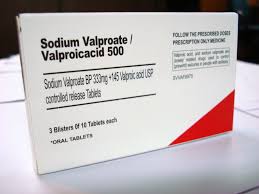
It is a chemical compound used as a mood-stabilizing drug and anticonvulsant, primarily in the treatment of epilepsy, bipolar disorder, and less commonly major depression. More
It is a chemical compound used as a mood-stabilizing drug and anticonvulsant, primarily in the treatment of epilepsy, bipolar disorder, and less commonly major depression.
Valproic acid or valproate
: 2-Propylpentanoic acid; 99-66-1; Dipropylacetic acid; Depakene
Divuna-ER, Encorate, Encorate Chrono, Epilex, Epival, Epsoval, Epsoval-XR, Manoval, Soric, Torvate, Torvate Chrono, TP Valpro-300, Val, Valance SOLN, Valate, Valkid, Valparin, Valpofin-CR, Valporate Chrono, Valporil, Valporil CR, Valprid, Valprol SYR, Valrate-CR, Valric, Valtec, Valtec-CR, Valtril, Zorat
2-propylpentanoic acid
Oral absorption
Valproic Acid dissociates to the valproate ion in the gastrointestinal tract and then binds to and inhibits GABA transaminase. The drug's anticonvulsant activity may be related to increased brain concentrations of gamma-aminobutyric acid (GABA), an inhibitory neurotransmitter in the CNS, by inhibiting enzymes that catabolize GABA or block the reuptake of GABA into glia and nerve endings. Valproic Acid may also work by suppressing repetitive neuronal firing through inhibition of voltage-sensitive sodium channels. It is also a histone deacetylase inhibitor. It also has been shown to be an inhibitor of histone deacetylase 1 enzyme (HDAC1). HDAC1 is needed for HIV to remain in infected cells.
The recommended dose is 15 mg/kg/day per oral.
For treatment and management of seizure disorders, mania, and prophylactic treatment of migraine headache.
Nausea, vomiting, abdominal pain, headache, lung inflammation, hair loss, infections, night blindness and heart burn.
Contraindicated in patients with known urea cycle disorder and hypersensitivity.
Store it at room temperature.
144.2114
C8H16O2
99-66-1