Vancomycin is an antibiotic used to treat a number of bacterial infections. It is recommended intravenously as a first-line treatment for complicated skin infections, bloodstream infections, endocarditis. More
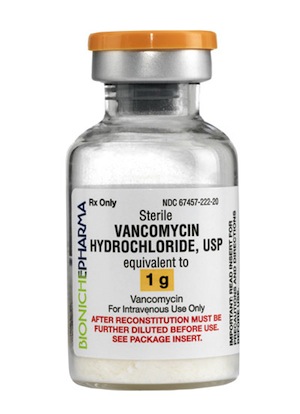
Vancomycin is an antibiotic used to treat a number of bacterial infections. It is recommended intravenously as a first-line treatment for complicated skin infections, bloodstream infections, endocarditis.
Vancomycin
Vancocin; Vancoled; Vancomicina; Vancomycine
Ancomycin, Celovan, Covancin, Cp-Van, Cytovan, Forstaf, Van-CP, Vanacin-CP, Vanco-L, Vancocare, Vancocin-CP, Vancogen, Vancogram-500, Vancoled, Vancomate, Vancomycin, Vanconat, Vanconex CP, Vanconis, Vancorid CP, Vancorin, Vancoser, Vancotar, Vancotech, Vancowar-CP, Vanking, Vanlid, Vanmax, Vansafe, Vantox-CP, Vanzy, Vconat, Vlorag, Wancosan, Xplocef
(1S,2R,18R,19R,22S,25R,28R,40S)-48-{[(2S,3R,4S,5S,6R)-3-{[(2S,4S,5S,6S)-4-amino-5-hydroxy-4,6-dimethyloxan-2-yl]oxy}-4,5-dihydroxy-6-(hydroxymethyl)oxan-2-yl]oxy}-22-(carbamoylmethyl)-5,47-dichloro-2,18,32,35,37-pentahydro
Poorly absorbed from the GI tract.
It is a tricyclic glycosylated non ribosomal branched peptide produced by the fermentation of the Actinobacteria species Amycolatopsis orientalis (formerly Nocardia orientalis). Vancomycin has been shown to be active against most strains of the following microorganisms, both in vitro and in clinical infections
The recommended dose is 0.5-2 g/day in 3-4 divided doses for a period of 7-10 days.
Prescribed for severe bacterial infections.
Stevens-Johnson syndrome; toxic epidermal necrolysis, blood dyscrasias such as neutropenia or thrombocytopenia. Ototoxicity, nephrotoxicity, eosinophilia, "red-man" syndrome, urticaria, thrombophloebitis, hypersensitivity reactions.
Hypersensitivity to the drug; history of impaired hearing; IM administration.
Store at 15-30°C.
1449.254
C66H75Cl2N9O24
1404-90-6